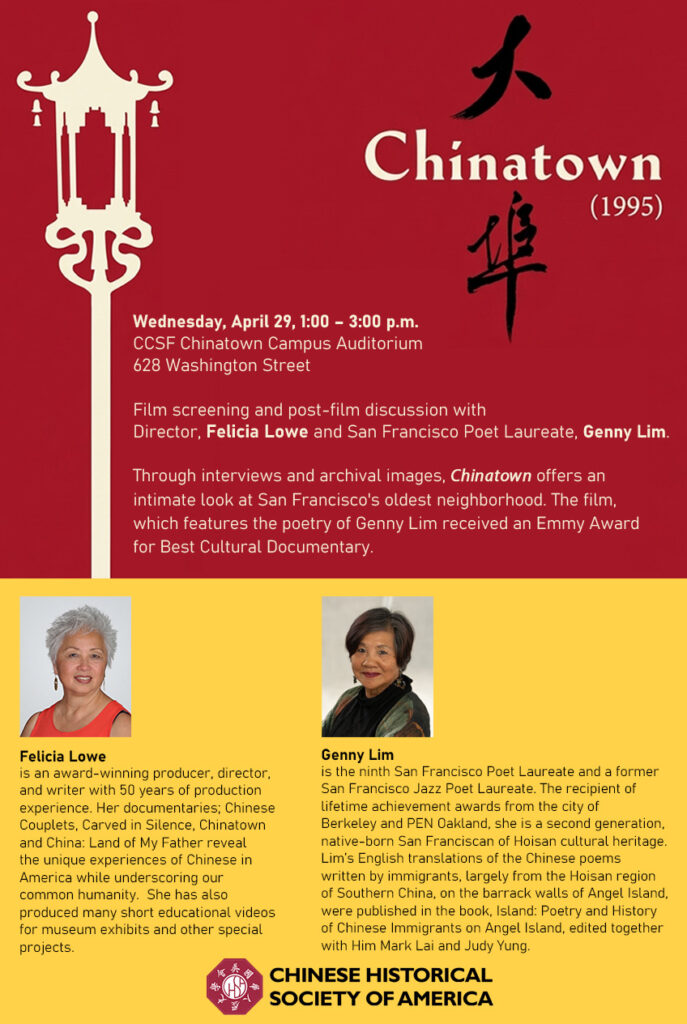
Wednesday, April 29,
1:00 – 3:00 p.m.
CCSF Chinatown Campus Auditorium, 628 Washington Street
Film screening and post-film discussion with Director, Felicia Lowe and San Francisco Poet Laureate, Genny Lim.
Through interviews and archival images, Chinatown offers an intimate look at San Francisco’s oldest neighborhood. The film, which features the poetry of Genny Lim received an Emmy Award for Best Cultural Documentary.
“Chinatown is definitely a living neighborhood, one that reflects, almost block by block, the long struggle of a people trying to gain a foothold here, often against overwhelming odds.”
FELICIA LOWE
Chinatown — A Portrait of a World-Renowned Neighborhood
Neighborhoods: The Hidden Cities of San Francisco – Chinatown premiered Wednesday, July 30, 1997 at 10pm ET on PBS
https://www.pbs.org/kqed/chinatown/ctpr.html
Thousands of tourists flock through its streets every day; its curio shops, all-night restaurants and crowded alleys have been celebrated from Broadway to Hollywood. But few people know the human drama and history that are hidden in the streets and faces of San Francisco’s Chinatown. This one-hour documentary tells the neighborhood’s story from the point of view of those who have lived their lives there, from the first immigrants who came to “Gold Mountain” in search of work and wealth, through the pain of a century of isolation and racism, to the recent arrivals who even today are revitalizing America’s gateway.

Early Chinatown was populated primarily by men, so it was called a “Bachelor Society.” It was a world without women, though many men were married with families in China. The Chinese Exclusion Act of 1882 banned the immigration of Chinese laborers for 61 years.
Photo Credit: D.H. Wulzen/Frank E. Wulzen

The Chinese Telephone, or “China 5” as it was called, served Chinatown’s residents from 1894-1949. It’s a perfect example of how the neighborhood took care of itself.
Photo Credit: Pacific Bell Museum Archives

Chinatown’s children had everything they needed within the boundaries of California and Broadway, Kearny and Powell. The public school, Commodore Stockton, was segregated until the 1940s.
Photo Credit: Chester Gan
Chinatown Resource Guide
https://www.pbs.org/kqed/chinatown/resourceguide
The oral histories and thoughtful profiles of CHINATOWN provide students and teachers with a colorful journey through the history of a unique neighborhood. Classes will find stimulating ways to study how immigrants contributed to the building of San Francisco and how the local and federal government responded to immigration in California during the last 150 years.
Educators can use CHINATOWN to integrate historical, geographic and economic topics into the curriculum. To help educators explore the rich historical materials, this resource guide provides lesson ideas for elementary, middle and high school. The program may be recorded off-air for educational use by K-12 schools and kept in perpetuity.
NEIGHBORHOODS: The Hidden Cities of San Francisco is an ongoing television series designed to explore the rich history of this unique American city. From the earliest Native American villages of the Mission District to the ethnic enclaves of Chinatown and North Beach, each program will reveal the city as a mosaic of communities with interconnecting pasts.
NEIGHBORHOODS:The Hidden Cities of San Francisco reveals the social, political, economic and cultural movements that create this city. Viewers will be fascinated by the stories as they discover the meaningful connections between our daily lives and our historical past. As we continue to grow in our appreciation of diverse cultures, NEIGHBORHOODS will give viewers a crucial sense of the traditions that link us, not only to the past but to one another.
Access the series online at the American Archive of Public Broadcasting.